
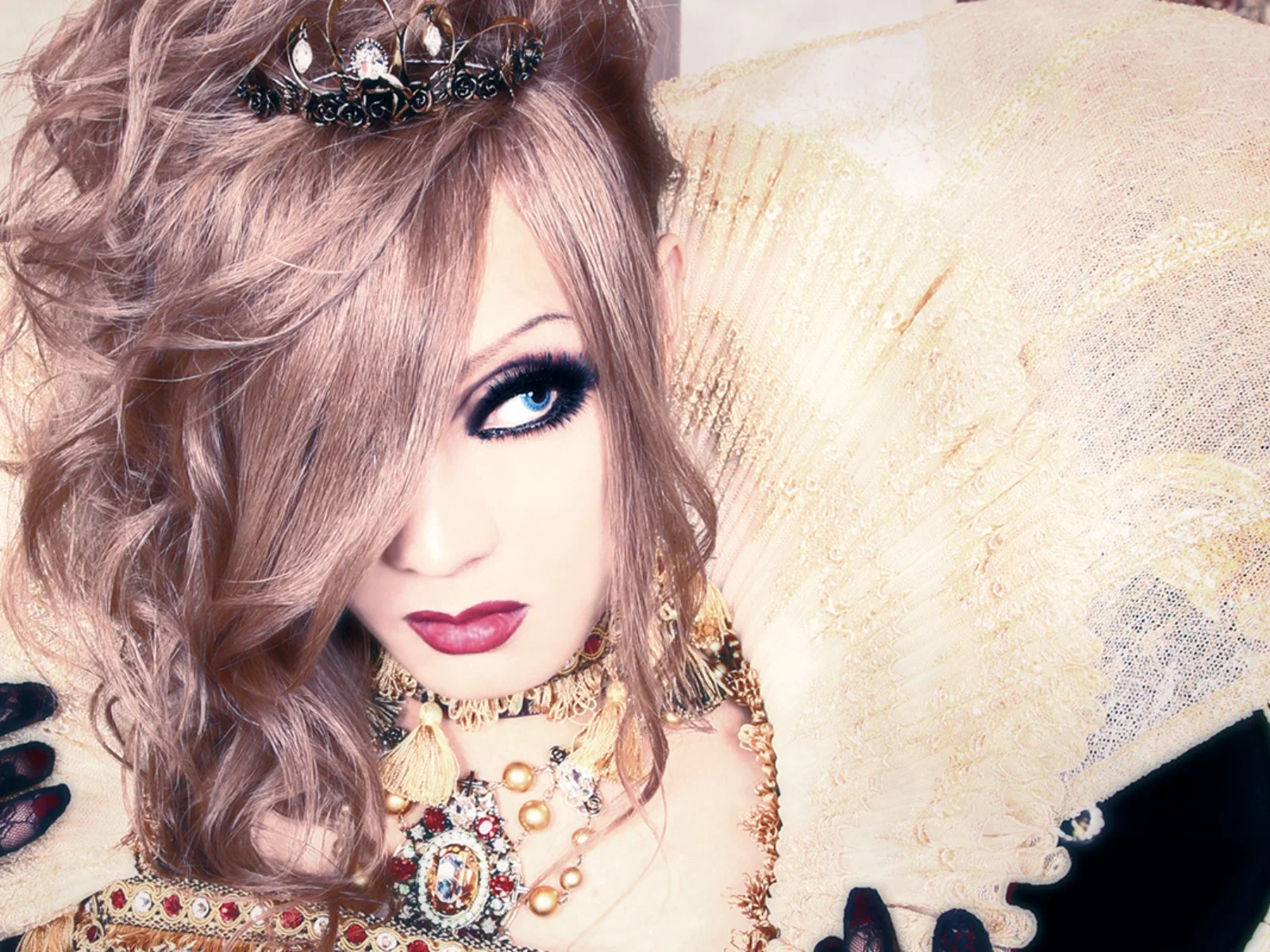
As one of the most recognizable artists in Visual Kei, Kaya has spent more than 20 years crafting a career defined by artistic freedom, elegance, and constant evolution. In this exclusive interview with Visual Violence, he reflects on the experiences that shaped his music, his admiration for MALICE MIZER, what he learned from working alongside Mana Sama, his memories of performing in Latin America, and the passion that continues to inspire him both on and off the stage.
Now, we leave you with the interview, translated into English.
1. How did Kaya begin as an artist? What was the origin or inspiration that led you to become a singer?
When I was three years old, I sang at a local festival and decided, "I'm going to become a singer!" After Schwarz Stein disbanded, I found myself on my own and decided to fulfill the dream I had since childhood of becoming a solo singer, so I began my solo career. I was greatly inspired by Japanese singers with a seductive presence and a very distinctive artistic world, such as Akina Nakamori and Momoe Yamaguchi. Since I was little, I have also loved watching stage plays, musicals, and kabuki, which continue to inspire my artistic expression.
2. Before starting your professional career, which artists, bands, or experiences had the greatest influence on your musicality and aesthetic?
As a singer, Akina Nakamori and Momoe Yamaguchi had a tremendous influence on me. As for bands, BUCK-TICK and L'Arc-en-Ciel were very important. But I think MALICE MIZER was the greatest influence of all.
3. Schwarz Stein is one of the most important projects of your career. How do you remember the beginning of your partnership with Hora?
I thought, "I want to make music with this person!" and now 24 years have passed since then. At first, it was his visual impact. I was incredibly impressed by how cool he looked. Then I fell in love with the quality of the songs he created, and before I knew it, 24 years had gone by. From the moment we met, I felt our relationship would last a long time.
4. Mana Sama played an important role in the early days of Schwarz Stein. What did you learn from working alongside such an influential figure in Visual Kei?
Mana Sama taught me that "when you present your work to the world and step onto a stage, you must have the determination to become involved in the lives of the people who receive it: listeners, audiences, and fans." Those words remain one of the fundamental philosophies guiding my activities to this day. Being able to work closely with Mana Sama, who not only created wonderful works but also had an enormous impact on spreading Gothic Lolita fashion, profoundly influenced the way I view life.
5. Your style has always stood out for its elegance, theatricality, and artistic sensitivity. How did you build that visual identity?
Since I was a child, I have loved extravagant performing arts such as theater and the circus, and during my school years I frequently attended theater performances. I also enjoy studying history and have a desire to bring the beauty and sensuality of the onnagata of Japanese kabuki into the present day. In addition, I believe that Japanese manga and anime, refined artistic forms developed over centuries, have also influenced the way I "express genuine emotions within unreal representations."
6. In Femme Fatale, you revealed a darker and more dramatic side of yourself. What did this project mean to you creatively and emotionally?
I have always worked as a solo singer, but I also love the sound of a band. At the time, I was thinking about how to express, through a band, the artistic sensitivity I had cultivated over ten years as a solo artist. Then I met some wonderful musicians, and Femme Fatale was born. Although we were only active for a year and a half, it was an exciting and deeply meaningful period.
7. After several years, Femme Fatale returned for a special reunion. How did it feel to perform those songs live again?
Since the band came to an abrupt end, I felt that we were finally able to give it a proper farewell with a final concert. It was also enjoyable to perform those songs from the past with the expressive abilities I have now. But above all, what made me happiest was seeing the fans so happy.
8. Many fans feel that your concerts are more like "works of stage art" than ordinary live shows. What emotions or worlds do you seek to convey on stage?
Japanese manga and anime are artistic forms that "express contemporary emotions within unreal representations." I enjoy "singing genuine emotions within a carefully constructed fantasy." Perhaps that is why my concerts resemble theatrical productions. Hearing people say that makes me very happy.
9. You have remained active for many years in a constantly changing scene. What do you consider most important in continuing to evolve as an artist?
"To change, while remaining the same." I always want to evolve by incorporating new forms of expression and vocal techniques. At the same time, it is important to preserve my principles, ideals, and convictions. I also believe it is essential, as a professional, to deliver performances that make fans think, "Yes, this is exactly what I wanted to see!"
10. Your performance at Mystical Fest in Mexico was very special for many Latin American fans. What memories do you have of that concert and the Mexican audience?
It makes me very happy that I can visit Latin America every year, especially Mexico, a place I deeply love. Last year I was able to go there with my dear friend HIZAKI, with whom I share many ideals, and I was also able to tour as Schwarz Stein. In addition, it was wonderful to spend time with Közi-san, whom I greatly admire. We even took photos together on stage while MALICE MIZER was playing in the background. It truly was an incredibly enjoyable time. It also made me very happy to see just how much people there love Japanese Visual Kei. I am sincerely grateful.
11. Your collaboration with Nocturnal Bloodlust surprised many fans. What was that experience like, considering your musical differences?
We shared the stage in Thailand last year! Although our music and methods of expression are completely different, the determination and conviction we bring when stepping onto the stage are the same. It was a very inspiring experience and a fantastic concert. The members were also incredibly kind people, and we had a lot of fun together backstage.
12. It is often said that Mexican Visual Kei fans are very passionate and expressive. Did you notice anything special when performing in Mexico?
The first time I performed in Mexico was in 2011. I was truly amazed by how loud the audience's cheers were! In Japan, many fans tend to be more reserved, so hearing such enthusiastic support made me incredibly happy. I could also feel how wholeheartedly everyone enjoyed the concerts, and that greatly lifted my spirits on stage.
13. You have also performed and held activities in Chile. What impression do you have of Chilean fans and Latin American fans in general?
In Chile, just like in Mexico, the fans cheer very loudly and enjoy the concerts with all their energy. That makes us want to respond with the same intensity. This mutual energy makes every performance become more passionate and more incredible than the last. Concerts in Latin America are always truly enjoyable.
14. Throughout your career you have explored darkwave, electronic music, metal, and gothic music. Is there any style or concept you would like to explore in the future?
I would like to challenge myself with more classical vocal styles, such as musicals and canzone italiana. I always have so many things I want to do!
15. Finally, what message would you like to give to your Latin American fans who have supported you for so many years?
To all of you, whom I love deeply: This year marks the 20th anniversary of my solo career. If I have been able to keep singing for so long, it is thanks to my fans. The warm support I receive from everyone in Latin America is also a source of strength that inspires my music. Thank you so very much, always. I have released a new work titled "WORLD." It is a positive, warm, and love-filled song. Whenever you feel lonely, please listen to "WORLD" and think of me. From distant Japan, I am always thinking of all of you. Let us continue living together from now on as well. I hope I can see you again. With all my love and a heartfelt embrace.
View original post on Instagram